
Books and reading
It's the perfect way to spend your summer.

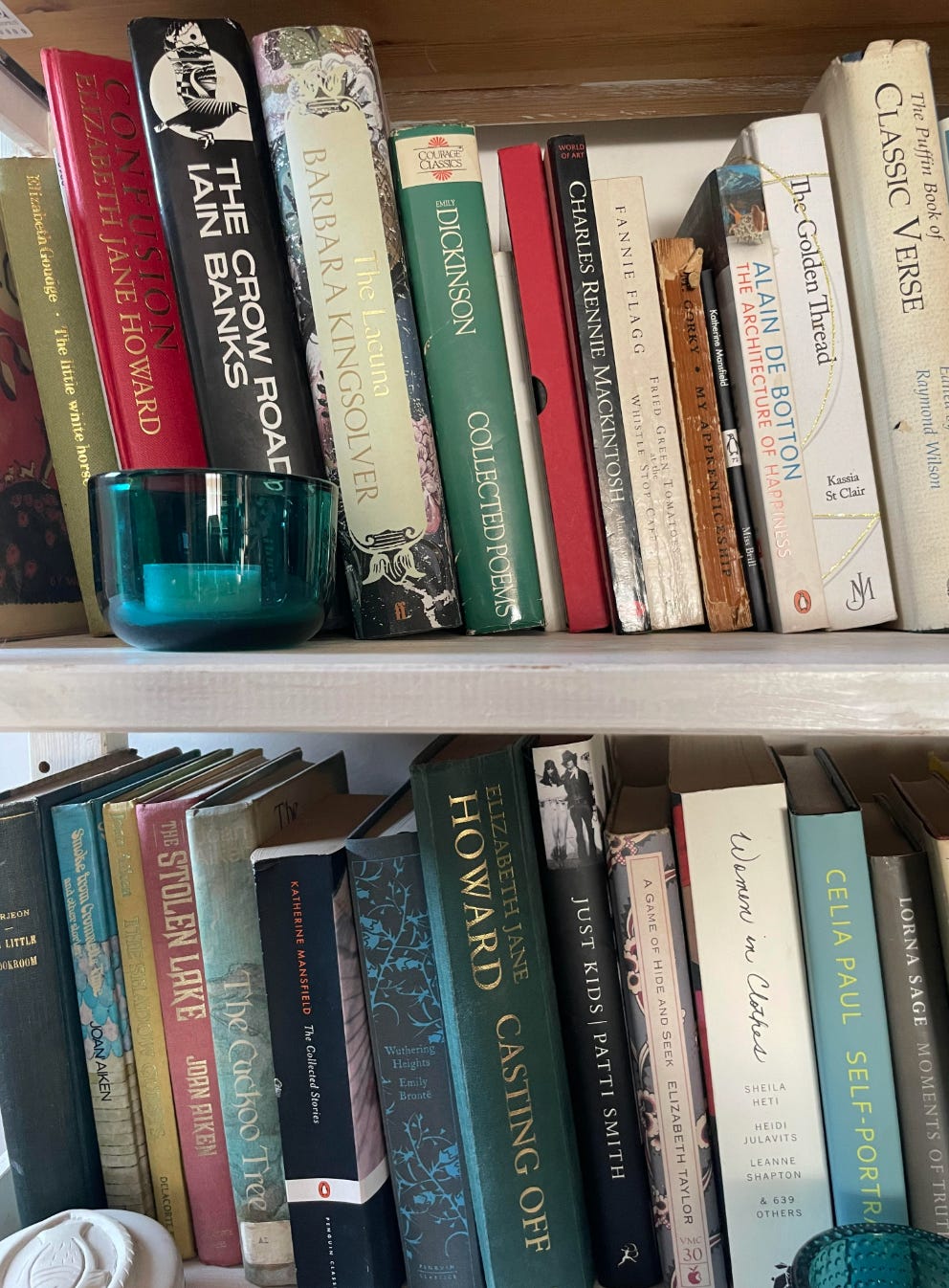
Every summer, when I’m reading on my kindle, I remember the summer I read The Poisonwood Bible. It was hot in my kitchen, where I was holding the massive paperback in one hand and washing up with the other, and even hotter in the book, where people’s skin was peeling off. Barbara Kingsolver was one of my favourite authors, and I read and reread all her books numerous times, but I knew that while The Poisonwood Bible had me absolutely gripped so that I had to go about my days with it held up in front of my face until I finished it, I would never read it again. The reason I remember it is because I mourn the way I used to read, all to aware now that my attention span is corrupted by scrolling and snippets of information. I do make efforts to combat this: Substack is my only social media, precisely because I appreciate the long-form content (long-form in comparison to an Instagram caption, but hardly an actual tome), and my evening ritual is reading in the bath, which mainly follows through to reading until I fall asleep. But I kept longing for stretches of time to read, and although I read constantly during the lead up to my operation, I wasn’t able to concentrate much. I designated my convalescence as my dedicated reading time, loaded up my kindle with books I wanted to read, and held off until I got into my hospital room, when I went for it with a vengeance.
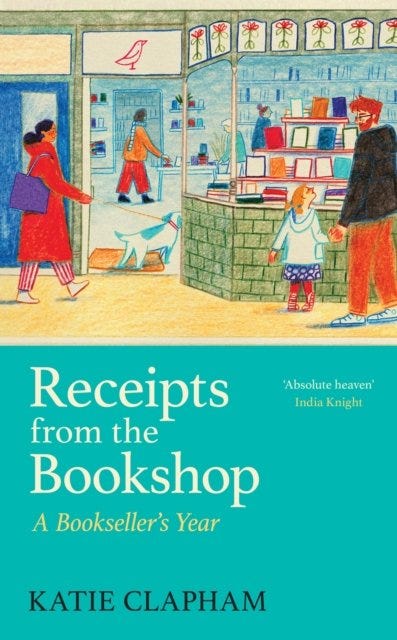
And now I’m reading Receipts From The Bookshop by Katie Clapham which is just as lovely as her substack. It makes me long for a bookshop of my own, it makes me remember so many that I have visited, and it fills me with guilt for the physical books I don’t buy (novels. I buy plenty of kids’ books and design books).
My father was a secondary school librarian. He got a job one summer, waiting for a new contract at another job, which was to organize the books in the library of one of the International schools im Rome, and he ended up staying on. Some of the books he bought, some he inherited (a complete set of back copies of Life magazine, for example). Every book had to be catalogued by hand, and that was the unpaid summer labour of my sister and I (every book in the school, including textbooks). My father believed that you should be allowed to read whatever you like, and the shelves of the library were wide-ranging, eclectic and mainly uncensored. I spent summers reading my way around the whole library: fiction Austen-Zola, taking in the complete works of Anais Nin on the way, followed by poetry, drama, auto- and biography. Some of these books. stayed with me forever, some of them warped me forever, and some I read far too young and didn’t properly appreciate until I was considerably older. Lots of this reading was definitely performative, but there’s no denying I read them all; apart from the yearly bookfair, or infrequent trips to Glasgow, the school library was pretty much our sole access to books in English, and all the books we had at home had been re-read so many times we knew them off by heart.
With the advent of cheap air travel came more trips to the UK, and in those heady days when baggage allowances were more a suggestion than a binding contract, I would load up my case with books. On one memorable trip I managed to bring back a grand total of 32 books - I had to buy an extra suitcase - mainly by dint of taking advantage of every “buy two get one free” offer I could find. I spent that long hot summer lying on the tiled floor of my living room, reading my way through them.
Now when I’m reading Receipts From The Bookshop, I think guiltily that I would have been one of the enthusiastic browsers not buying anything: art books are too heavy for my suitcase now, and I only consume fiction on my kindle (mainly because of eyesight). But last summer I made a point of buying a children’s book in every independent bookshop I saw, and I plan on keeping that up for a while.
And while my father was always the procurer of books, both my parents always had their head in a book while I was growing up. Since my father died, my mother’s already prodigious consumption of books has doubled, and it’s no easy feat to make sure her devices are constantly loaded with reading matter. This is where my guilt over reading on a kindle rather than holding an actual book in my hand dissipates: my eyesight isn’t up to reading a novel, but I’m fine with art or design books, which I can dip in an out of, and which tend to be altogether bigger with larger format print. These are also the books that I read deliberately, making sure I have time to dedicate to them, and plenty of light to do so. But I want to read novels in my dark bedroom and kitchen, in the bath, and then I need something light and backlit. My mother couldn’t possibly read a book if it wasn’t on a screen,, and then what would she do? Watch TV all the time that she is alone? She just wouldn’t: her TV consumption tends to be limited to an hour or so a day. When she was confined to bed, she could at least escape into books, and now that she is pretty much confined to home, she has the vastness of literature on her screen to choose from.
I read half of two books in hospital, and finished them at home: Yesteryear, and You Are Here. I have thoughts about both. First the David Nicholls: I loved You Are Here, and it’s the perfect convalescence book. It’s funny, and thoughtful, and I enjoyed reading it. Yesteryear was unexpected, even though I knew the basic premise, and also that it had an unlikeable narrator. I didn’t read any of the online discussion until I had finished it, and I was surprised at the topics which most engaged the forums - to me Natalie’s biggest enemy was her mother. I thought the book had a lot to say about social conditioning and performative living, about women’s lack of agency and about how destructive a malignant parental influence can be, but it all lacked a bit of depth. I suspect the story was not much improved by being workshopped by Hollywood; the written word can say things that film cannot, and vice-versa, and the best film adaptations can often take a perfect story and expand it in unexpectedly nourishing ways, and I wonder how much that becomes truncated when the two collide too early.
What occurred to me after reading both (completely unrelated) books was that I was drawing a comparison between reading and relationships. I always want to be in a relationship with someone I secretly think is more intelligent than me (also important is that they secretly think I am more intelligent than them, of course. And the point isn’t that anyone is cleverer than anyone else, it’s just being in love with someone’s mind, and knowing that there are areas where their expertise is superior). And I want that relationship with a writer I am reading, where I feel they respect my intelligence, but can still surprise me with their skill and wit, so that I marvel at their understanding of human nature and gasp at their ability to think up a cracking plot, and swoon at their efforts to keep me engaged.
I didn’t get that with Yesteryear, it just all felt a bit thin. Somewhere it was described as a “darkly humorous satire”, and I completely missed the bit where anything was actually funny. The David Nicholls, however, made me laugh out loud several times. I will confess to feeling quite biased against him as an author, purely because of the success of One Day, despite the fact that I had read his earlier books and enjoyed them. I didn’t particularly like One Day, although it was fine, and I was very unreasonably annoyed that it was so successful and hyped, men and women sitting on public transport all summer glued to their copies. The reason I was so annoyed was that the book was a well-written story of the kind dismissed as “chick-lit”, but because it was written by a man, men read it, and discovered that as a genre, well-written chick-lit is entertaining and insightful and funny and often moving. Not that the men would ever have known this of course because they thought this book was unique and a trailblazer, and it would have never occurred to them to pick up something similar by a female author.


I read Karen Karbo’s interview with Caitlin Shetterley about her new book, The Gulf of Lions, which referenced her previous one, Pete and Alice in Maine, so I decided I should read that first. It’s about a family of New Yorkers (Pete and Alice and their two daughters) who flee Covid by heading to their holiday home in Maine, because there’s no Covid there. Unsurprisingly, the locals are not thrilled and cut down trees on their land to keep them quarantined. Even when the quarantine period is over, Pete and Alice have escaped NY Covid, but not themselves.
I normally try to avoid books set in Italy, or at least approach with caution, because they can get it so wrong, but I absolutely loved the romp that is Villa Coco by Andrew Sean Greer and have recommended it to everyone I know as a perfect summer read.
Dream State by Eric Puchner was one of those books that I found myself wandering around the house reading as I did other things (at one point I had to accept that I just couldn’t really read it and iron art the same time). My preference is for books that are character rather than plot driven, and I loved how this book meandered about between the past and the future, taking me along with it.
The next thing I read was Good People on India Knight’s recommendation, although my reading guru Natasha Poliszczuk also recommends it. I forgot this was supposed to be a whodunnit because I got so caught up in the story, and this was another I couldn’t put down.1
Up next on my reading list: Whistler by Ann Pratchett, Mayflies by Andrew O’Hagan, and Heart The Lover by Lily King which for some reason I am putting off, even though I love Lily King. When I read less, I am more careful about what I read, as though everything has to keep some kind of equilibrium, whereas when I read constantly, I can absorb the books that will throw my balance off, and that’s what I need to regain - that feeling that I don’t have to be safe all the time, I can weather a few emotional literary punches.
I can feel though, that I am back in the rolling rhythm of reading books as my chief form of entertainment again, and I am so glad of it.
Creating an echo

When I became an art teacher, I inherited a curriculum which I loved, and a room full of amazing art supplies. The first order I made was for books.

Thanks Louise, I do like the sound of lots of those books and I did enjoy that David Nicholls one (which I listened to as an audiobook). One thing very much in his favour, my brother who works as a delivery driver in Norwich has met him a couple of times and says how nice he is. And I have seen for myself how David Nicholls promotes writers who are just starting out. So I can forgive him for being so successful!
I love that you were washing up with one hand with a book in the other. What a wonderful image! My house is piled with books: costume, art, sewing, knitting books in my office in the loft, novels in the bedroom, interiors and gardening in the living room and the absurd quantity of cookbooks in the kitchen. I long to read for hours a day, but like you, it’s in the bath or before sleeping. I loved the scenes in Gavin and Stacey when Gwen and Nessa would both sit down with a book after eating an omelette for lunch.
My mum who lives on her own, spends all day reading. I have listed your recommendations to share with her and my sister. I’ve just started Still Life by Sarah Winman, which was recommended by someone on Substack but I can’t remember who! Let’s shove our phones in a draw and pick up books again!